Replit Blog

 Mar 26, 2024
Introducing Scheduled Deployments
Today, we are launching Scheduled Deployments. This service allows you to schedule your applications to run at predetermined time intervals seamlessly. Specify when the application should run in natural language, and Replit will take care of the rest. Scheduling has always been a popular use case on Replit, but configuring an application like this was difficult. Most developers set up schedulers by deploying an infinite loop that constantly checked the time to a Reserved VM. This process not only had a lot of overhead, but was also inefficient and costly. Now, you can write something like, “Run this script every Tuesday and Thursday at 3:00 PM,” and we’ll generate the cron expression for you so that you can focus on building. What you can build In our closed beta, developers have used Scheduled Deployments to build applications like:
 Mar 18, 2024
More Reliable Connections to Your Repls
At Replit, session success rate is one of our service level objectives (SLOs). This means that any legitimate incoming request from a client should always be successfully connected to its target Repl. Failure to do so is a bad user experience. To abstract away intermittent infrastructure failures when you connect to a Repl, we use a reverse WebSocket proxy between the user’s client and the remote VM hosting Conman, our container manager that runs all Repls in a container. The high-level view of this proxying looks something like this: In the above diagram, Regional Goval Cluster represents our backend, which is sharded per region for scale and to prevent cross-region latency and egress costs. You can read more about it in this blog post. The diagram illustrates that the reverse WebSocket proxy can attempt a retry if any failures occur during the connection setup with Conman. The proxy is alive throughout the connection and transfers data back and forth between the client and the user’s Repl. The problem Everything seems architecturally sound here, so what was the problem? Conman, technically our container manager and responsible for running Repls in containers on GCE VMs, also doubled up as our reverse WebSocket proxy. Here’s what our architecture and overall flow used to look like:
 Feb 22, 2024
Experiment: Figma to Replit Plugin
Turn your Figma designs into functional web apps with the new Figma to Replit plugin—streamline your design-to-code workflow and go from prototype to production in minutes.
 Feb 14, 2024
Sharding Infrastructure: The Regional Goval Project
The main task of the infrastructure team at Replit is to ensure your Repls run well. A Repl can be thought of as a Linux container with a filesystem. To run Repls, we need to take care of several pieces of infrastructure: Virtual machines to run Repl containers on Databases to keep track of container and VM states Cloud storage to store Repl contents Reverse proxies to route HTTP requests
 Feb 14, 2024
Introducing Multiplayer AI Chat
One of our core beliefs at Replit is that multiplayer collaboration makes building software more creative and efficient. After introducing Replit AI for All last year, we heard from our users how transformative AI has been to their development workflows. Today, we are announcing several updates to our AI Chat product, but most importantly, we are bringing the multiplayer power of Replit to AI. We will continue to offer AI to all users, with advanced models available for Replit Core members, but now with the ability to collaborate with others in multiple, persistent chat sessions. What's new? Multi-session chat with persistence You can now create and manage multiple chat sessions when interacting with Replit AI. Creating multiple threads with our AI products allows you to switch between asking for explanations about files in your codebase, generating code for a new feature, and debugging, all without losing your progress. This was a top feature request, and we’re excited to bring multi-session functionality to the platform so developers can stay organized and engaged, all within the same familiar workspace UI. Collaboration and multiplayer
 Feb 12, 2024
Flexible Credits and Usage-Based Billing
Replit has evolved from a simple online editor to a comprehensive end-to-end software development platform trusted by developers worldwide. As we’ve grown, we’ve introduced new tools and payment methods for services. We’ve recognized a desire among developers for greater control over their expenses on Replit, and today, we’re introducing usage-based billing. In January 2024, we enabled usage-based billing for any usage that exceeds your plan’s allotment. This change offers a more flexible and transparent view for managing development and deployment costs on Replit. Replit will continue to offer our powerful Starter and Core plans, and any usage beyond plan allotments will be billed via usage-based credit card payments. We’re confident these improvements will make using Replit to scale your projects easier. What's new? Flexible credits Previously, the Replit Core plan included specific allotments for Static and Autoscale Deployments. Feedback from our Replit Core community highlighted a desire for more versatile hosting options, particularly for bots (such as Discord, Telegram, Slack, etc.)
 Jan 11, 2024
Company Spotlight: Qdrant Vector Database
With the rise of new generative AI development methods like retrieval-augmented generation (RAG), it can be difficult to demonstrate technical setup to developers and highlight the potential front-end products that can be created by these developer tools. To speed up developer onboarding, Qdrant has developed several Replit templates. They simplify the initial steps for new developers, such as setting up the development environment and installing packages, making the onboarding process smoother and faster. What is Qdrant? Qdrant is a high-performance vector database used at companies like AlphaSense, Disney, Flipkart, HRS, HP, Bayer, Dailymotion, Deloitte, Microsoft, Mozilla, and others. Qdrant exposes both HTTP and gRPC APIs so that you can integrate it with any programming language. They also have official Python, JS/TS, Rust, and Go SDKs, and various integrations with the most popular LLM frameworks, such as LangChain, LlamaIndex, and Deepset Haystack. Qdrant also has a custom extension of the HNSW algorithm, enabling both rapid and precise Approximate Nearest Neighbor Search, which is essential for real-time applications.
 Dec 27, 2023
Replit in Review: A Recap of What We Shipped in 2023
In 2023, we brought the vision of idea to software, fast, to reality. We shipped the first conversational AI programmer to code your ideas faster, made AI available for everyone, and introduced Deployments to ship from where you write your code. We made coding on Replit a better and more productive experience by redesigning the Console, Git integration, Packages tool, and more. We released the Replit Desktop App so you could choose the form factor that works best for you. We’re not finished making Replit the best place to code, but here are some highlights from the past year! Product (01/29) Git in the Shell - The first step in improving our Git integration. Git command-line tools were improved and integrated with your GitHub account, allowing access to your repositories. (02/14) Announcing Ghostwriter Chat - The first conversational AI programmer. Ghostwriter Chat is a beta release that acts as a proactive debugger and understands your project’s context, making it a powerful AI pair programmer.
 Dec 26, 2023
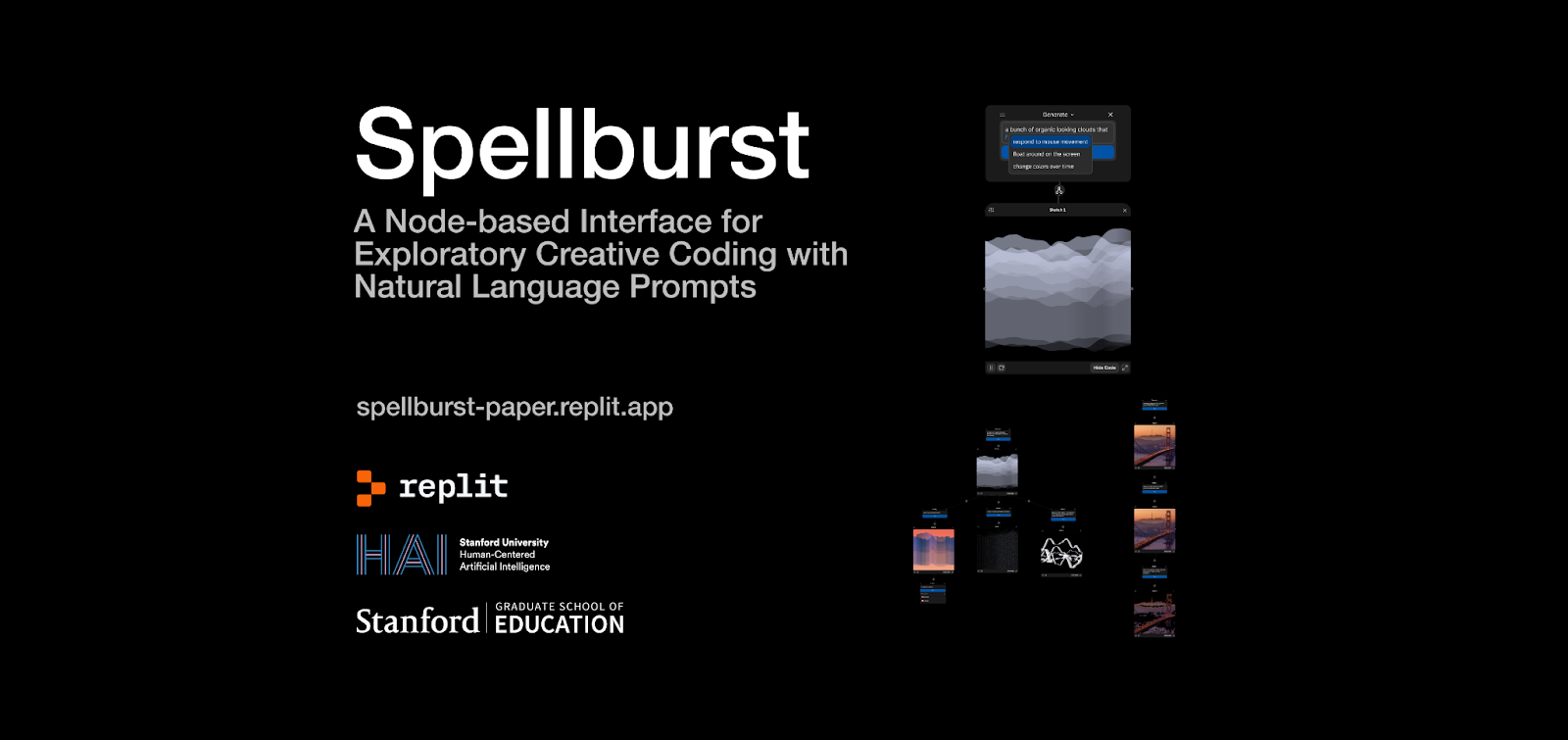
Introducing Spellburst, A Replit x Stanford HAI Collaboration
At Replit, we’re lucky to work with brilliant people who are building the programming tools of the future. This past year, we had the privilege of sharing some of this design work with the broader academic research community. Tyler, design engineer at Replit, teamed up with Stanford University (Jenny Han – also former Replit intern), Miroslav Suzara, Christopher Pondoc, and Dr. Hari Subramonyam) to publish Replit’s first-ever peer-reviewed publication, Spellburst. In November, we presented our work at the ACM Symposium on User Interface Software and Technology (UIST), one of the premier venues for human-computer interaction research in the world. This post will walk through what we built and researched, what we learned from the process, and some predictions for user interface design and AI in the future. Introducing Spellburst We went into this project knowing that we wanted to design for learning and creativity for coders. In our formative study, we interviewed 10 expert generative artists to understand their existing workflows. What we discovered about the exploratory process for creative work is that creative coders are constantly: Going from idea to code
 Dec 22, 2023
Builder Profile: Ismail Pelaseyed
Ismail Pelaseyed is the CTO and co-founder of Superagent, an open-source framework that enables developers to build, manage, and deploy AI Assistants. Ismail is an experienced developer who is dedicated to building open source software. After many years of running a successful consulting firm with his business partner, Alan Zabihi, they wanted to go back to building projects for themselves, focusing primarily on open source AI and agent frameworks. Eight years ago, Ismail and Alan built KeyCrunch (now Hyperdrive), which automatically writes marketing copy for users. They continued to expand the function of KeyCrunch into a tool that generates ad materials with the help of AI agents. Their goal was to get mainstream developers without expertise in ML to integrate AI into their applications. The company was eventually acquired by Jetshop, but Ismail and Alan continued to focus on agents and accessible AI dev frameworks in their next project: Superagent.
 Dec 21, 2023
Company Spotlight: CrewAI
AI agents are here to stay Large Language Models (LLMs) are everywhere, doing various jobs, from chatting to parsing documents. Soon after LLMs took the world by storm, developers started creating more focused, goal-oriented LLM apps modeled after human reasoning and problem-solving, which became known as AI agents. Here’s how one company is leveraging LangChain and Replit to solve complex tasks. AI agents with CrewAI CrewAI is a library specifically designed to build and orchestrate groups of AI agents. It's made to be straightforward and modular, so integrating it into your projects is a breeze. Think of CrewAI like a set of building blocks - each piece is unique, but they're all designed to fit together smoothly. Built on top of LangChain, it's inherently compatible with many existing tools, including local open-source models through platforms like Ollama. The AI agents can run natively on the cloud with Replit, making it even easier to get started with CrewAI. Check out the CrewAI templates on Replit to see the agents in action. Or, use them as a starting point for your own projects so you don't have to start from scratch. Here’s how it works.
 Dec 20, 2023
9 AI Templates and Playgrounds for Your Business
Integrating the latest AI tools into your team can be a significant advantage. However, assessing these tools and setting them up to run can take time and effort. Whether you’re testing a new large language model or building a prototype with a vector database, chances are somebody has already developed a similar AI tool. Increasing developer productivity is a cornerstone of Replit, and we want to give you the tools to elevate your team and quickly incorporate the latest AI developer tools into your business. Fork one of the AI templates below and customize it for your requirements. Once you’re finished, you can deploy it with just a few clicks from Replit and share it with your team. In this post, we’ll highlight some of the top templates on Replit that can help you explore and integrate the latest AI developer tools. 1. Gemini vs GPT-4 Easily integrate and compare the two top-performing LLMs with this starter code. Each of these templates contains the proper way to make API calls to Google’s Gemini API in JavaScript and Python.
 Dec 15, 2023
Updates to Social Features on Replit
In 2024, we're excited to introduce improvements to our social features on Replit, all centered around making it easier to share and explore code. We learned from our top creators that a cover page's primary value is sharing code and giving other developers something to fork. Additionally, we recognized that viewing applications in an iframe is a suboptimal experience. Often, missing Secrets prevented the program from running as intended. The best way to view someone’s work is to visit the production deployment directly. With this in mind, we’re reimagining cover pages to focus primarily on code consumption. This shift marks a move away from running and viewing program outputs. Instead, we’re making these pages a hub for exploring and understanding code. Starting early next year, when you land on a cover page, it will show the project’s code or README file. They’ll be presented in an intuitive, editor-like environment for more straightforward navigation. When you find a project you want to work with, forking it is straightforward. We’ll set up an identical development environment for you so you can start making changes or running the code immediately.
 Dec 13, 2023
Showcasing Startups on Replit
The fastest way to start, ship, and share The Replit platform isn't just a sandbox; it's a launchpad. There’s a lot to learn from startups building on Replit and how they leverage the platform to monetize and grow. Whether it’s a solo developer bootstrapping their startup on Bounties, or a startup launching their application on Replit Deployments, Replit is the best place to get from idea to software, fast. Here are a few companies building and shipping on Replit today. Lumiwealth The last thing financial traders want to do is spend hours learning how to set up a development environment just to deploy a trading algorithm. Why can’t writing code for a new algorithm be as easy as writing in a Google Doc? These were the questions Robert Grzesik had when starting his company Lumiwealth. With Replit, he could onboard hundreds of students into the real work of developing trading algorithms rather than lose much of his community in the complexity of setting up a development environment.
 Dec 11, 2023
8 Templates for Businesses on Replit
Whether you’re building an AI support agent for your customers or a web scraper to collect marketing data, chances are somebody has already developed the tool you’re about to build for your team. Increasing developer productivity is a cornerstone of Replit, and we want to give you the tools to elevate your team and business practices quickly. Fork one of the templates below and customize it for your specific requirements. The app you build and deploy can scale with your business and adapt to changing goals, and you can use our AI code assistant to fine-tune it. In this post, we’ll highlight some of the top templates on Replit that can help you automate routine tasks, enhance customer experience, make data-driven decisions, and innovate your marketing and outreach strategies. 1. AI Support Agent Combine your documentation and internal knowledge with GPT-4, and get an agent that walks your users through basic product issues and questions. This template uses OpenAI, Pinecone, and LangChain to vectorize the files you upload and provide context to the AI. Fork the template and follow the instructions in the README.md file to get started building your AI-powered chatbot. In this demo, we embedded Replit documentation, and our agent can answer questions about Replit features and common bugs.