Replit Blog
 Nov 26, 2024
So you suspect you have a memory leak...
Programming languages with Garbage Collectors are fantastic! You no longer need to keep track of every single piece of memory that your program needs to run and manually dispose of them. This also means that your programs are now immune to bugs like double-free (accidentally freeing a resource more than once, leading to crashes or security vulnerabilities) and most memory leaks (accidentally not freeing a resource, leading to crashes by running out of memory). But it is still possible to have a memory leak. Consider this TypeScript snippet: The global cache makes fibonacci fast, but it relies on a global cache that has no way of being cleared, so it will always accrue memory when it is called with larger and larger numbers. Slowly but surely. At some point during the development of Replit Agent, one of our engineers spotted the following graph in our dashboard: We had strong evidence that the agent processes were running out of memory roughly once an hour, and that likely means a memory leak. Since we were constantly serializing each agent process’ state to its Repl, we were able to recover without losing any data, but that meant that we had to re-run several LLM calls, and those tend to add up. This also implies that users would sometimes see some spurious slowdowns, so that was suboptimal too.
 Nov 13, 2024
Zero to MVP
Since joining Replit, I’ve faced a harsh truth—I’ve never written a line of code. As a UC Berkeley student studying business journalism, coding feels out of reach. I’ve had countless app ideas but would always hit the same wall: Who can build this for me? That’s until I discovered Replit. It's a platform that brings ideas to life fast—no technical background needed. Replit bridges the gap between creative vision and actual execution. Making Ideas Happen
 Nov 12, 2024
SpotHero: Innovation through Rapid Prototyping
SpotHero: Innovation through Rapid Prototyping With Replit Teams, the SpotHero marketing team has developed internal tools, data integrations, and prototypes to seamlessly and cost-effectively integrate disparate departmental systems. “Rapid prototypes that don’t tie up product and engineering teams with unproven methods are vital for innovation. Replit enables us to cycle quickly, helping us determine which projects are worthy of greater effort from our limited internal teams and which should continue to run departmentally.” SpotHero overview SpotHero is the leading parking reservation marketplace that helps drivers find, compare, and reserve parking across 300+ cities in the U.S. and Canada. Since being founded in 2011, SpotHero has helped drivers park over 75 million cars.
 Nov 4, 2024
How we name things
What’s in a name? Well, a lot, but first and foremost: stress. Whether we’re naming our babies, pets, companies, or features, we tend to worry a lot about finding the perfect name. We know intuitively that a name will shape how something is perceived and even influence its direction going forward. And yet, this stress isn’t equally distributed. In business, people tend to think a lot about the names of the companies they’re building but leave each product and feature name up to whoever thinks of the best-sounding name first.
 Oct 11, 2024
Shell2: 200× faster, persisted, multiplayer-native Shells
What even is a terminal? Back when computers were still in their infancy, the “computer” usually was a big cabinet in the middle of a room. They typically exposed some internals via a front panel with lots of knobs and ports. Users would connect a terminal device (sometimes called a teletype or a TTY) to this front panel in order to input text and print the corresponding output. In the 1970s when microcomputers like the Apple I started becoming more mainstream, displays and keyboards started to be integrated into the computers themselves. The rise of the graphical user interface meant that the displays and keyboards weren’t just used for the terminals themselves but for various other graphical programs too. At some point, smart computer people thought “wait a minute, we can make a graphical program that just emulates what a terminal would have done anyways!” and thus the terminal emulator was born. In these emulators, the wires of the traditional TTY are replaced with pairs of file descriptors (an abstraction for a stream of bytes) known as the PTY (short for pseudo-TTY). Importantly for Replit, the PTY doesn’t use a serial port to connect the TTY to the computer which means we can operate a PTY remotely over a network!
 Oct 8, 2024
From localhost to live
If you have a body, you are an athlete. Bill Bowerman, Co-founder, Nike The title "programmer" was always reserved for those who code. So it make sense that shipping software is synonymous with, well... writing code. But is the hardest part about shipping really learning to code? I wish. The hardest part(s) are everything that lives between localhost and live. Today, we're seeing a new class of builders—the AI native developer. These users have some technical prowess and build through clever use of the latest tools. But the problem was never just writing code. Despite lower friction to code, roadblocks still exist. Where, you ask?
 Sep 16, 2024
Introducing Replit Agent
Last week, we launched Replit Agent, our AI system that can create and deploy applications. Now, with only a few sentences and a few minutes, you can take an application from idea to deployment. You can think about the Agent like a pair programmer. It configures your development environment, installs dependencies, and executes code. From your laptop or the Replit mobile app, the Agent is changing how our users build software. If you'd like to learn more, we've compiled some of our favorite examples, tutorials, and articles on the agent so far.
 Aug 26, 2024
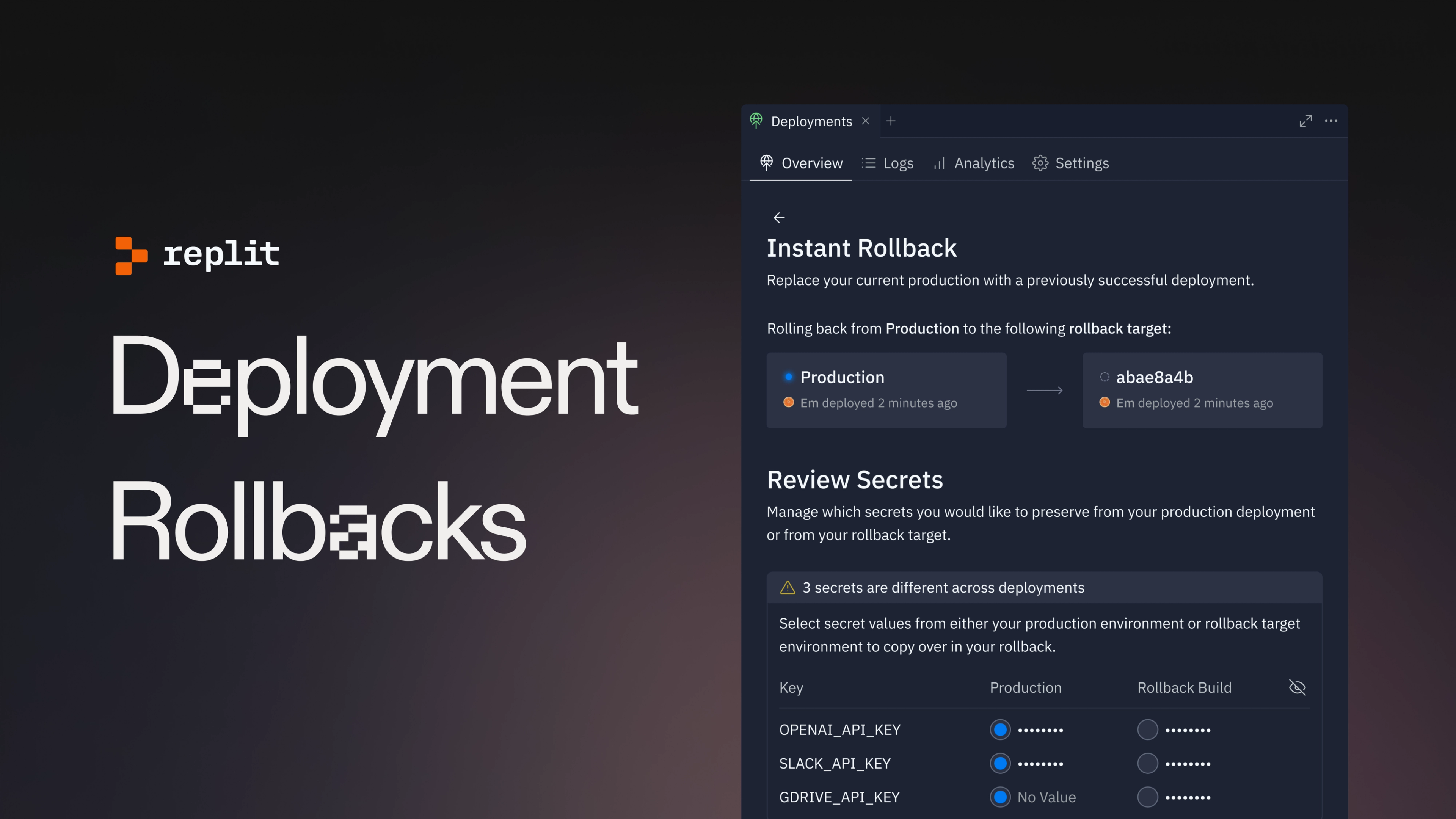
Introducing Deployment Rollbacks
Deployment rollbacks are a new feature that allow you to quickly and confidently version your deployments. Rollbacks allow you to restore a previous successful deployment in one click: fix a broken build or a typo in seconds. A quick tour Let’s explore the new additions to the deployment experience. Rollback activation
 Aug 20, 2024
Rebranding Replit: Inspiration to Action
At Replit, AI isn’t merely a footnote to our work. Our mission is to democratize software development, and AI is a step change in our ability to do so. The scale of this change was so significant—both for our company and the industry at large—that we realized we had to explore and refine the Replit brand. We had a lot to say in a market that was becoming increasingly noisy. But we had a problem: The previous design didn’t quite capture the history of our industry or our company, and our brand needed to demonstrate both to communicate a compelling perspective. As we refined, we worked from two parallel histories: The history of Replit and the progress we’ve made helping software creators go from idea to software, and the history of computer science and the progress the entire industry has made, ranging from the earliest mainframes to the most powerful LLMs. We planted our starting point years before Replit was founded As we’ve built Replit, from its earliest versions to our current AI features, we benefited from the work of people before us. There’s a confidence and humility to knowing this, that we’re proud of our work and grateful for the work that made it possible, that we wanted to translate into our brand.
 Aug 14, 2024
How Replit makes sense of code at scale
For any company making creative tools, being able to tell what its most engaged users are building on the platform is critical. When the bound of what’s possible to create is effectively limitless, like with code, sophisticated data is needed to answer this deceivingly simple question. For this reason, at Replit we built an infrastructure that leverages some of the richest coding data in the industry.
 Jul 19, 2024
Introducing Replit Projects
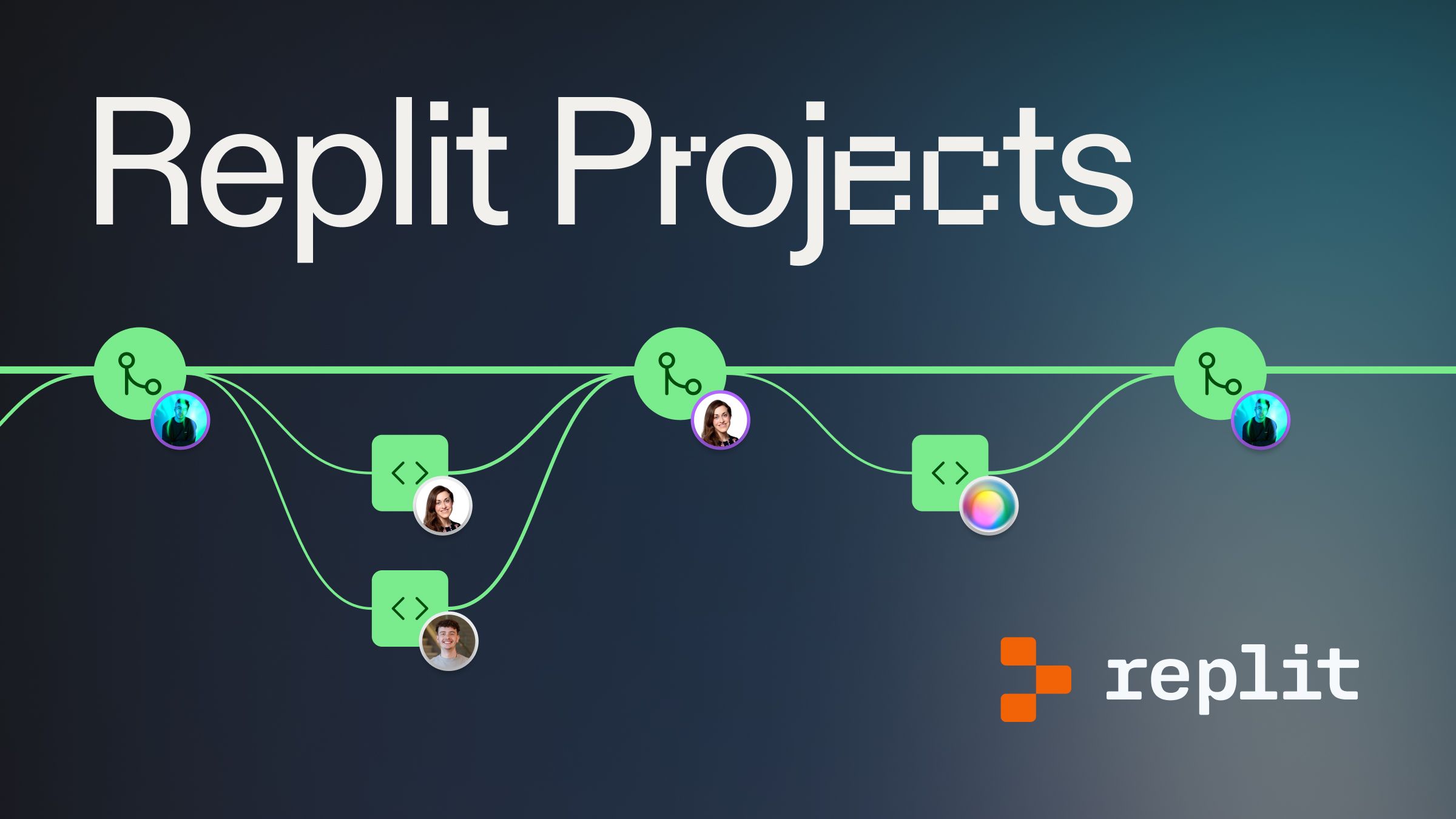
We’re excited to announce Projects for Replit, a new way to collaborate with your team. This feature is in beta now, available to all Replit Teams customers. Projects let you maintain multiple versions of your team’s codebase and easily merge your changes together when you’re ready. Anyone on your team can “fork” (create a new copy of the code), make changes, preview what changed, and then merge those changes back into the main version with a few clicks. If you weren’t using Replit, it might take a new teammate hours to set up their local development environment, make their changes correctly, and get their code reviewed and merged. Why use Projects? As a team writing software, collaboration is important. Realtime coding or pair programming is useful, but sometimes you need your own space to work. If your whole team was working on their ideas in a realtime session at the same time, one person writing some invalid code would stop everyone else from being able to test their own code. And sometimes, you might want to test out an idea without knowing for sure if it’s the right approach, and be ready to scrap it if it doesn't work out.
 Jul 16, 2024
Introducing Replit Teams
In today's fast-paced work environment, using real-time collaboration tools like Google Docs and Figma comes naturally to most of us. As a result, we've come to expect a lot more from our tools. Yet, when it comes to building software, we often find ourselves stuck with tools built for a different era — tools that cause our teams to feel siloed, inefficient, and less collaborative overall. In decades past, the software development lifecycle looked like a rigid industrial process: product managers would hand off documents to designers, and designers would hand off mock-ups to engineers. Today, however, the process is much more fluid and cross-functional. Engineers contribute to design, product managers prototype, and designers code. Still, engineering tools have remained inaccessible to everyone except engineers, preventing meaningful contributions from other roles, and slowing everyone down. This led us to wonder: What would it look like to design software collaboration tools that truly meet the changing needs of 21st-century teams? Introducing Replit Teams Go from idea to software faster than ever before. Today, we’re announcing that Replit Teams is generally available and here to set a new standard for building software.
 Jul 15, 2024
SkillsEngine: Accelerating product & design with Replit Teams
Replit Teams transformed the SkillsEngine Product and Design team from a traditional no-code department to a prolific team that writes, shares, and ships code. In the process, the team unblocked engineering bottlenecks, improved prototype fidelity, shipped faster, and saved thousands of dollars and resources. "I have tried every no-code tool and AI app. I have been coding for nearly 15 years now. Nothing has sparked the creative code output that Replit has for me. I have coded more in the past 12 months than the previous 10 years because it makes it so easy to get started and just try stuff. We can just focus on building ideas.” - Max Miner, Executive Director of Product and Design SkillsEngine overview SkillsEngine develops data services and tools for employers, educators, and workforce interests. Employers use SkillsEngine data to confidently assess their workforce capabilities and hiring needs. Educators use features like skill-based job profiles to plan curricula that meet current job market needs. Challenges
 Jul 1, 2024
Improved Dependency Management
We recently revamped the dependency management experience in your Replit workspace. You can now use and configure multiple languages in one Repl. We’ve consolidated language support, packages, and system dependencies into one new Dependencies pane for beginners and experienced developers alike! System Dependencies and Modules At Replit, we want to make it as easy as possible to spin up a project in the language of your choice without spending too much time on configuration. But, sometimes you have more specific requirements! That’s where System Modules and Dependencies come into play, under the “System” tab. We support most programming languages by bundling language servers, formatters and packagers via System Modules. For example, for Python there’s the Python Tools module, for Node.js there’s the Node.js Tools module, and so forth. If you use a template or import a project via GitHub, we do our best to automatically install the modules you need. If you want to use additional languages, you can simply add Modules that suit your needs. Under the hood, system modules are powered by Nix.
 Jun 6, 2024
Announcing Replit Guides
Today, we are launching our first version of Replit Guides. Guides provide end-to-end content for learning new skills and building new applications. We are launching with an initial set of guides in partnership with some of the best in tech. Check out Replit Guides. Why Are We Launching Guides? Empower the next billion software creators. That’s the Replit mission. We continue to build an end-to-end development platform that allows people of all backgrounds, demographics, and skill levels to go from idea to software, fast. Platform updates and advances in our AI features are making Replit more powerful, while simultaneously lowering the barrier to entry.